
Community Colleges & Community
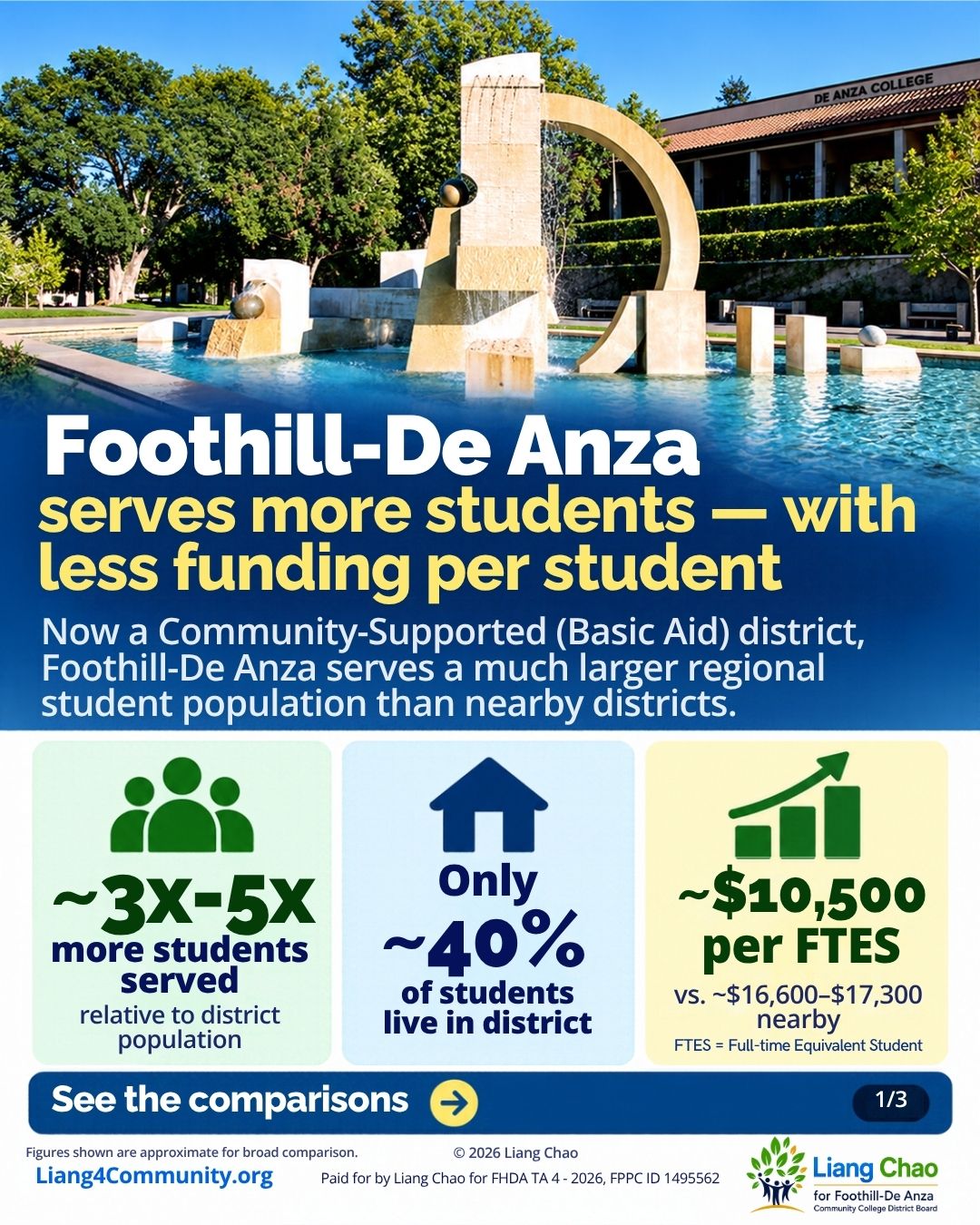
Foothill-De Anza Serves More Regional Students With Less Funding per Student
What Should That Mean for Local Residents?
October 13, 2026 · By Liang Chao
Summary
- For a home with an assessed value of $1 million, nearly $1,000 a year goes toward our community colleges — about $700 through the basic property tax plus roughly $286 in Foothill-De Anza bond taxes.
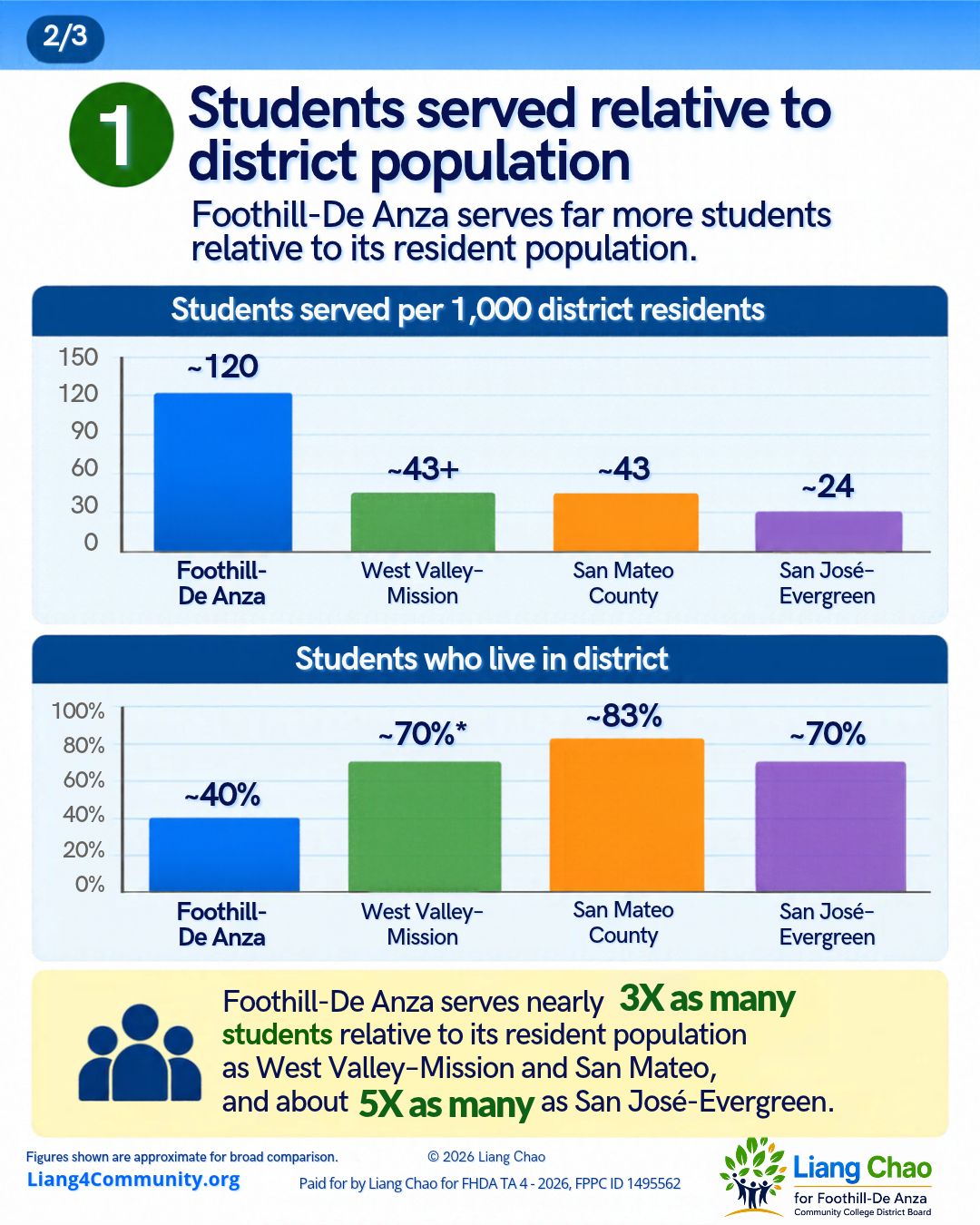
- Foothill-De Anza serves about 120 students for every 1,000 district residents — nearly three times the rate at West Valley–Mission and San Mateo, and about five times the rate at San José–Evergreen.
- Only about 40% of Foothill-De Anza students live within the district, compared with about 83% in San Mateo and roughly 70% in San José–Evergreen.
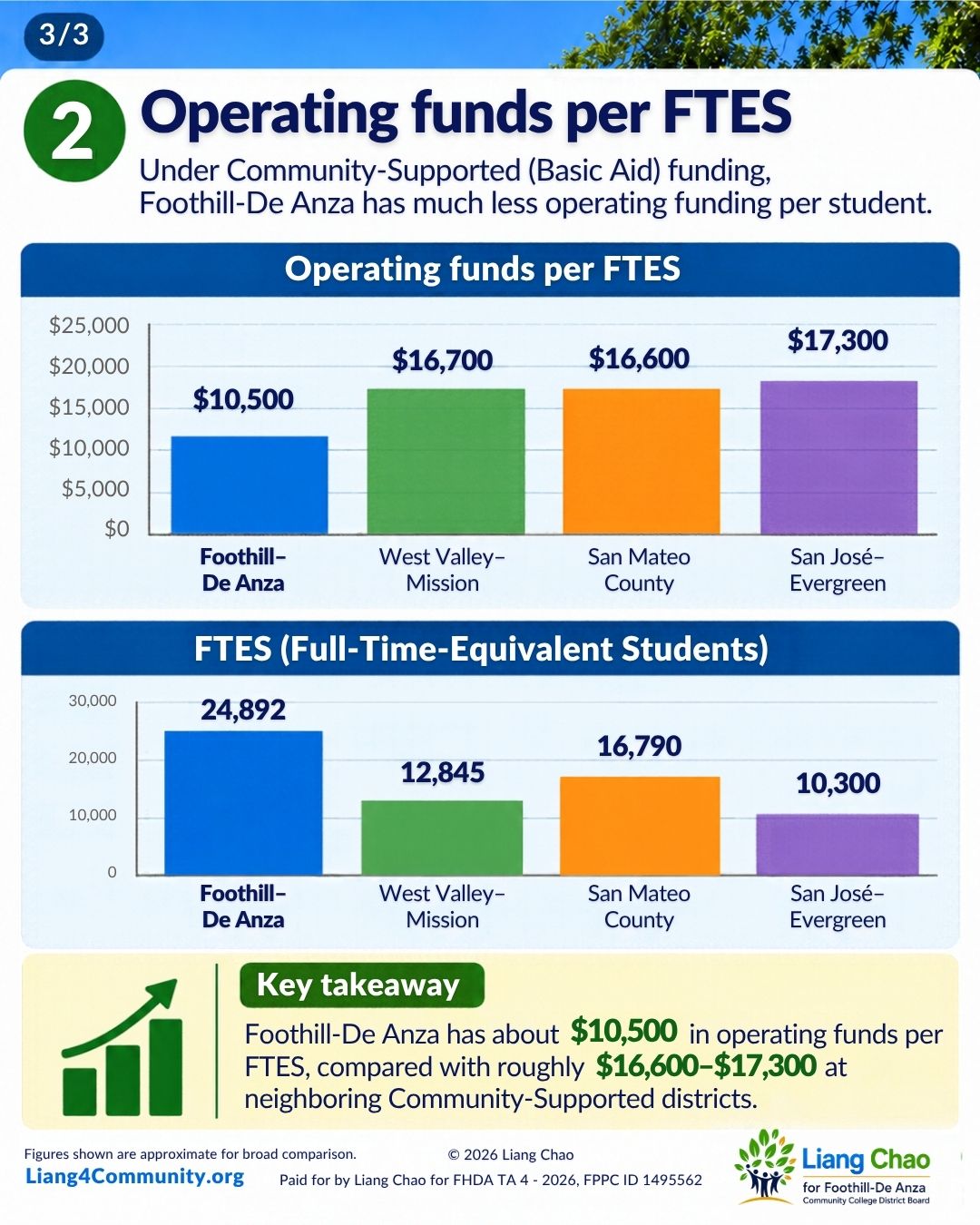
- Foothill-De Anza has about $10,500 in operating funds per full-time-equivalent student, compared with roughly $16,600–$17,300 at those neighboring Community-Supported districts.
- As a Community-Supported District, Foothill-De Anza no longer receives additional core state funding simply because enrollment grows — so more students can mean fewer operating dollars per student.
- Some other Community-Supported districts provide significant benefits to local residents: West Valley–Mission offers free enrollment to district residents, while San Mateo offers free enrollment to residents pursuing a degree or certificate.
These differences raise a larger question:
How should Foothill-De Anza use this new funding model while continuing to serve both local residents and its large regional student population?
How Nearby Community College Districts Compare
View Data
| District | Residents in district | Students served | Students per 1,000 residents | Students who live in district |
|---|---|---|---|---|
| Foothill–De Anza | ~433,000 | 51,875 | ~120 | ~40% |
| West Valley–Mission | 467,084 | 20,000+ | ~43+ | ~70%* |
| San José–Evergreen | ~900,000 | 21,713 | ~24 | ~70% |
| San Mateo County | ~764,000 | 32,626 | ~43 | ~83% |
Student-count definitions are not completely identical among districts. Foothill-De Anza, San José–Evergreen, and San Mateo figures are annual unique student counts. West Valley–Mission publicly reports “20,000+ students served.”
* NOTE: West Valley–Mission does not publish a directly comparable unduplicated in-district student percentage. The ~70% figure is a rough estimate based on 14,785 resident enrollments in 2025 and the district’s reported 20,000+ students served. Because the two figures use different counting methods, the percentage should be treated as approximate rather than exact.
When Local Property Taxes Become the Main Funding Source
Foothill-De Anza has entered a different funding environment.
For many years, Foothill-De Anza served enough students that its local property-tax revenue alone was not enough to fund the district under California's funding system, so the state provided additional funding. More recently, local property-tax revenue has grown while enrollment has declined from its historical peak, part of a broader statewide trend.
That balance has now changed.
Foothill-De Anza has become a Community-Supported District, also known as Basic Aid. In practical terms, the district will now rely primarily on local property taxes rather than state funding for its core operating budget.
For a home with an assessed value of $1 million, nearly $1,000 a year goes toward our community colleges — about $700 through the basic property tax plus roughly $286 in Foothill-De Anza bond taxes.
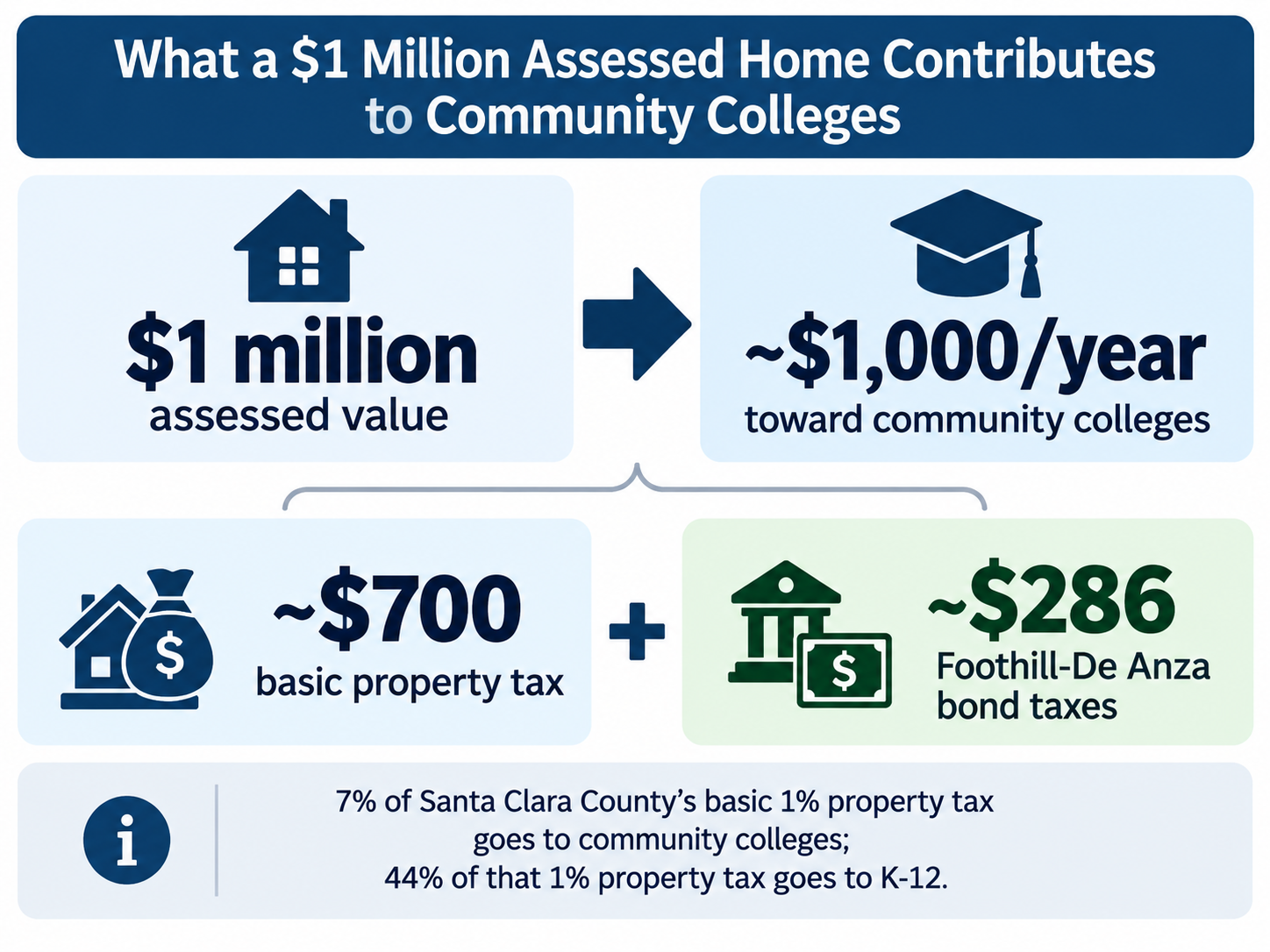
Many residents may not realize how directly their property taxes support community colleges. In Santa Clara County, about 7% of the basic 1% property-tax levy goes to community colleges. For context, about 44% goes to K–12 schools. Properties within the Foothill-De Anza district also pay voter-approved community-college bond taxes, which account for the additional amount above.
Foothill-De Anza's relatively late transition to Community-Supported funding is partly a result of its unusually large student enrollment. More students meant a larger state funding entitlement, so local property-tax revenue had to rise further before it could replace state funding.
Foothill-De Anza serves nearly three times as many students relative to its resident population as West Valley–Mission and San Mateo, and about five times as many as San José–Evergreen.
View Data
| District | Students per 1,000 residents | Students who live in district |
|---|---|---|
| Foothill–De Anza | ~120 | ~40% |
| West Valley–Mission | ~43+ | ~70%* |
| San José–Evergreen | ~24 | ~70% |
| San Mateo County | ~43 | ~83% |
* NOTE: West Valley–Mission does not publish a directly comparable unduplicated in-district student percentage. The ~70% figure is a rough estimate based on 14,785 resident enrollments in 2025 and the district’s reported 20,000+ students served. Because the two figures use different counting methods, the percentage should be treated as approximate rather than exact.
Only About 40% of Foothill-De Anza Students Live Within the District. Foothill-De Anza serves far more students relative to its resident population, while a much smaller share of its students live within the district.
Had Foothill-De Anza historically served enrollment closer to those neighboring districts, its state funding entitlement would have been much lower, and it likely would have become Community-Supported much earlier.
A Strong Regional Role — With Lower Funding per Student
Foothill-De Anza serves a large and highly regional student population. Many students attend part time, so the number of individual students served is substantially larger than the district's full-time-equivalent student count.
Foothill-De Anza's reach also extends well beyond its district boundaries.
In Fall 2023, 8,295 students living in San José or Milpitas attended De Anza College — more than attended either Evergreen Valley College or San José City College individually.
Source: San José–Evergreen Community College District, 2025 External Environmental Scan
That illustrates the important regional role Foothill and De Anza play throughout Silicon Valley.
But under Community-Supported funding, serving more students no longer brings a comparable increase in core funding. At the same time, Foothill-De Anza has about $10,500 in operating funds per full-time-equivalent student (FTES), compared with roughly $16,600 - $17,300 at the neighboring Community-Supported districts.
View Data
| District | FTES | Operating funds per FTES |
|---|---|---|
| Foothill–De Anza | 24,892 | ~$10,500 |
| San Mateo County | ~16,790 | ~$16,600 |
| West Valley–Mission | 12,845 | ~$16,700 |
| San José–Evergreen | ~10,300 | ~$17,300 |
FTES means full-time-equivalent students and combines students’ course loads into the equivalent number of full-time students. “Operating funds” refers to unrestricted operating/general-fund revenue available for general college operations. District accounting practices differ somewhat, so these figures are intended as broad comparisons.
At a June 24, 2026 Board of Trustees presentation, Foothill-De Anza reviewed its districtwide enrollment and demographic trends. Its enrollment heat map shows the district's regional reach, with student concentrations extending across the South Peninsula and into San José, Santa Clara, and Milpitas — well beyond the district's boundaries.
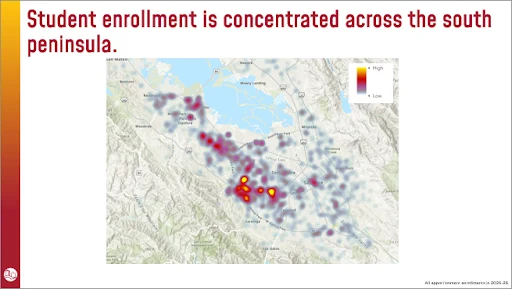
The Board presentation focused on Foothill-De Anza's own enrollment and demographic trends; the cross-district comparisons in this article were not part of that presentation.
What Could Community-Supported Funding Mean for Foothill-De Anza?
Foothill-De Anza's transition to Community-Supported funding comes at a time when the district is working with less operating revenue than under its previous funding environment.
Neighboring Community-Supported districts have made different choices about how local funding benefits residents. West Valley–Mission offers free enrollment to district residents, with no income requirement and no requirement to pursue a degree or certificate. San Mateo waives enrollment fees for district residents pursuing a degree or certificate.
Class-enrollment thresholds also differ: Foothill-De Anza generally uses 20 students, compared with about 16 at West Valley–Mission and 15 for many San Mateo classes.
Foothill-De Anza is also redesigning its Resource Allocation Model because the old model relied heavily on enrollment, while enrollment is no longer the main driver of district revenue under Community-Supported funding.
That creates important choices about whom the district serves, what benefits local residents should receive, how classes and programs are offered, and how limited resources should be allocated.
Questions We Should Be Asking
Who should Foothill-De Anza serve?
- How should the district balance its regional role with service to local residents?
- Should Foothill-De Anza continue seeking enrollment growth when additional students no longer bring comparable core funding?
- Should the district seek additional revenue by growing international and out-of-state enrollment?
What benefits should district residents receive?
- Should district residents receive free or reduced enrollment fees?
- Should they receive priority access to high-demand classes, where legally permitted?
- Should some seats in oversubscribed classes be reserved for district residents?
How should classes and programs change?
- Should Foothill-De Anza lower its minimum-enrollment guideline for keeping a class open?
- Should more low-enrollment classes be preserved when students need them to complete a degree, certificate, or transfer pathway?
- Should there be more evening, weekend, hybrid, and short-term courses for working adults?
- Should Foothill-De Anza expand short-term and stackable certificates?
How should limited resources be used?
- Which investments would provide the greatest educational value?
- Which new programs can be sustained over time?
- How should the district prepare if property-tax growth slows?
An Opportunity to Think Differently
Foothill-De Anza enters Community-Supported funding with an unusual set of challenges.
Only about 40% of its students live within the district, even though local property taxes now provide most of its core operating funding. At the same time, Foothill-De Anza has substantially less operating funding per FTES — neighboring Community-Supported districts have about 60% more.
Yet Foothill and De Anza also play an important regional role, serving students from throughout Silicon Valley. In some neighboring communities, more residents attend Foothill-De Anza than attend either college in their own community college district.
The transition gives Foothill-De Anza an opportunity to reconsider how enrollment, class offerings, student benefits, and resources should be aligned under this new funding model.
The central question is:
How can Foothill-De Anza use its available resources to provide the greatest educational value — to its students, the broader region it serves, and especially the local communities that fund it?
References
- Foothill-De Anza Community College District — 2025–26 Adopted Budget. Used for Community-Supported/Basic Aid transition, unrestricted general-fund revenue, enrollment/FTES context, and nonresident-tuition revenue. 2025–26 Adopted Budget
- Foothill-De Anza Community College District — Chancellor, “Planning for Our Future Community Supported District,” August 25, 2026. Used for the explanation that funding is now less dependent on enrollment and for the district’s transition planning. Chancellor’s August 25, 2026 message
- Foothill-De Anza Research and Planning — “Presentation of Districtwide Trends,” June 2026 Board study session. Source for the enrollment heat map and districtwide enrollment/demographic discussion. Districtwide Trends presentation page
- Foothill-De Anza Research — Student Headcount by Academic Year. Reports 51,875 unduplicated students in 2024–25 and the distribution of full-time and part-time course loads. FHDA student headcount report
- Santa Clara County Controller-Treasurer — Property Tax Distribution Charts. Reports that 7% of the basic 1% property-tax levy goes to community colleges and 44% to K–12 schools. Santa Clara County property-tax distribution
- Santa Clara County — 2024–25 Tax Rate Book. Source for Foothill-De Anza voter-approved bond tax rates used to calculate approximately $286 per $1 million of assessed value in a typical Cupertino tax area. Santa Clara County 2024–25 Tax Rate Book
- West Valley–Mission Community College District — 2020 Census Redistricting Plan. Source for the district population of 467,084. WVMCCD redistricting plan
- West Valley–Mission Community College District — Free Community College. Source for free enrollment for district residents. WVMCCD Free Community College
- San José–Evergreen Community College District — 2025–26 Tentative Budget Presentation. Reports 21,713 unduplicated students in 2024–25 and district enrollment trends. SJECCD 2025–26 Tentative Budget Presentation
- San José–Evergreen Community College District — 2025 External Environmental Scan. Source for the finding that 8,295 San José/Milpitas residents attended De Anza College in Fall 2023, more than attended either Evergreen Valley College or San José City College individually. SJECCD External Environmental Scan
- San José–Evergreen Community College District — 2020 Census / District demographics. Reports a service-area population of about 890,000. SJECCD
- San Mateo County Community College District — District Fact Book. Reports 32,626 unduplicated students in 2024–25 and $278.1 million in unrestricted general-fund revenue for 2025–26. SMCCCD District Fact Book
- San Mateo County Community College District — Free College. Source for the enrollment-fee waiver for San Mateo County residents intending to earn a degree or certificate. SMCCCD Free College
- San Mateo County Community College District — Course Cancellation Guidelines. Source for the class-enrollment thresholds used in the article, including 15 students for many face-to-face/hybrid/synchronous classes near the start of term. SMCCCD course cancellation guidelines
- San Mateo County Community College District — 2024 class-cancellation comparison. This Board presentation compares neighboring districts and reports an informal minimum of 16 students at West Valley–Mission and 20 at Foothill-De Anza, with exceptions. Class cancellation district comparison